Practical AI · Episode 01

Five businesses you could start with AI

Choose one bounded offer, understand who would buy it and work out what you must deliver. These are business hypotheses to investigate, not claimed customer results or market-rate research.

Full episode · Open guide and downloads · No signup required

Watch the full episode

Loading connects to YouTube. Then press the player’s Play button to watch. Reading and downloads work without loading YouTube.

8:49 · Practical AI from AlphaForge

Read the written explanation
Read the episode transcript

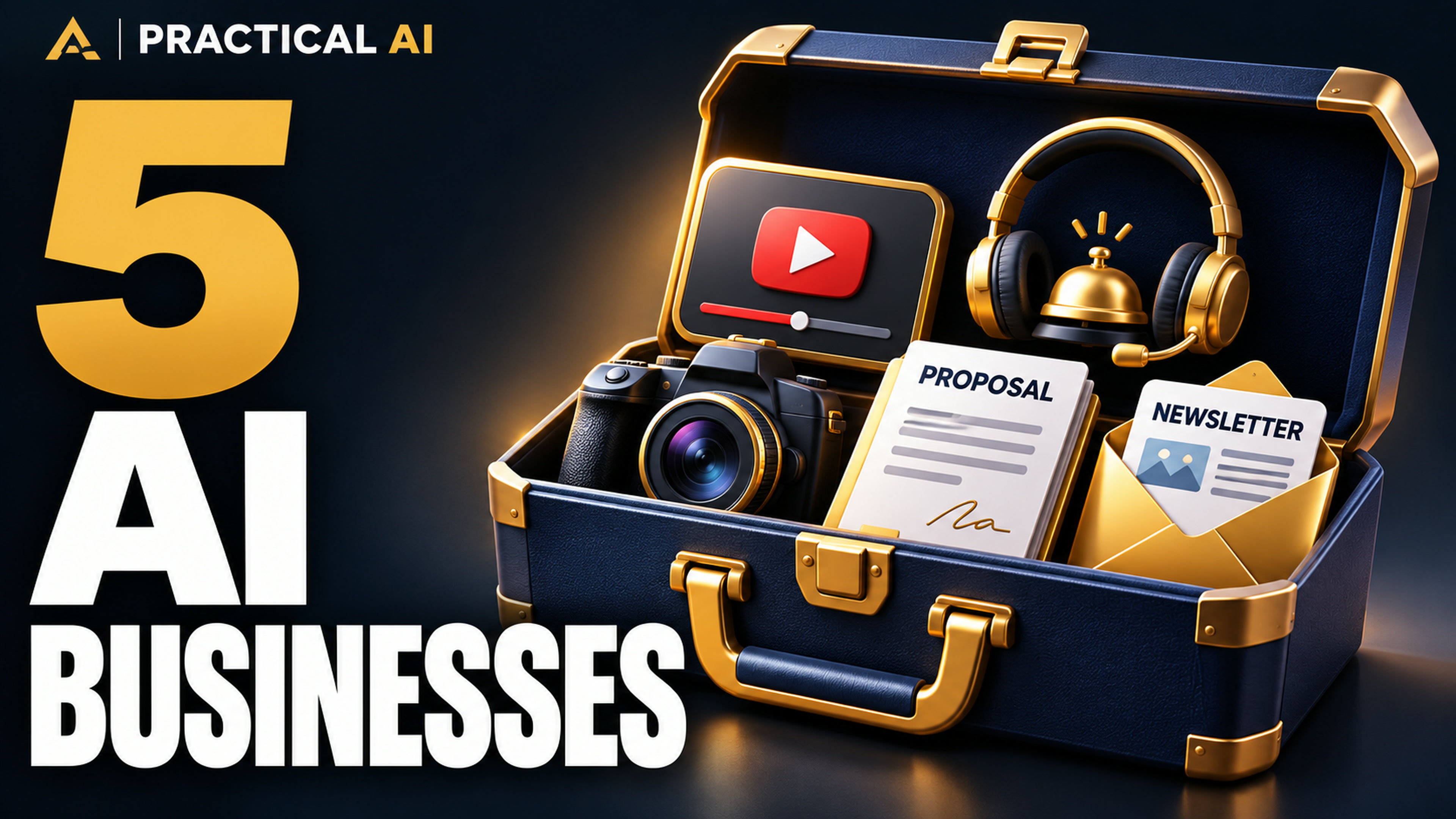
A creator needs a week of content. A local shop needs its phone answered. An online seller needs product images. Each of those could be the starting point for a business you run with AI. Here are five businesses you could start with AI: what you sell, who could pay you, and how to test your first offer.

I'm Mike Elliott. This is Practical AI from AlphaForge.

We're going from services you can demonstrate with a small sample to a business built around your own audience. For each one, I'll show you a concrete starting point. These are business ideas to test, not earnings promises, and the examples are illustrative.

Number one: a content repurposing studio.

Picture a consultant who records a useful thirty-minute webinar. There's a good explanation in it, a customer question, and a story that would work as a short video. But somebody still needs to turn that recording into a week's worth of content.

Your business does that production work.

The potential customer is a consultant, podcast host, educator, or founder who already records material and wants help distributing it. Start with people who have a recording habit; otherwise you're also signing up to chase them for footage.

Here's a specific offer: send me one recording, and I'll deliver three edited vertical clips, captions, a written post, and a short email based on the same material.

AI can transcribe the recording, suggest moments worth clipping, and draft the written versions. You choose the strongest sections, shape the openings, and finish the edits so each piece makes sense on its own.

For example, a fitness coach explains why beginners abandon workout plans. One clip answers that question. Another shows the simpler routine the coach recommends. The email gives readers a short checklist they can use that week.

That's a coordinated package built from the coach's actual expertise.

To test it, get permission to use one recording from a potential customer. Make one strong sample clip and show the proposed package beside it. Ask whether they'd pay for that delivery on a regular schedule. A paid pilot tells you more than compliments about the editing.

You could charge per recording or sell a recurring package with a defined number of deliverables. Before promising a monthly service, measure the editing time and revision time on that pilot.

If you're good at spotting a useful story, this is one to investigate. Now let's move from helping a business publish to helping it respond.

Number two: an AI receptionist setup service.

Imagine a small auto-detailing shop. The owner is working on a car when a call comes in. The caller wants to know whether the shop cleans fabric seats and whether there's an opening on Saturday.

Your business sets up an assistant that can answer approved questions, collect the caller's details, and help with scheduling where the system supports it.

The potential buyer is a business with repeat customer questions and a clear appointment process: a detailer, salon, cleaning company, or similar service business.

What you deliver is the configured assistant, the business's approved information, the booking or callback process, and a tested handoff to a person.

AI handles the conversation. Your work is learning the business's rules and connecting the assistant to the right information and systems.

For the detailing shop, that means knowing which services exist, what information is needed before quoting, and when a caller needs the owner. The assistant shouldn't invent a price for a job it hasn't assessed or promise an appointment it hasn't confirmed.

Start with a narrow pilot: answer a few common questions and capture callback requests after hours. Make it clear that callers are speaking with an automated assistant, and agree on how their details will be handled.

Before connecting it to customers, run test calls. Ask a routine question, ask something outside its knowledge, and ask for a person. Show the owner what happens in each case.

A possible business model is a setup fee plus ongoing support, with usage costs explained separately. Platform and phone usage can cost money, so agree on a pilot budget before connecting live calls. This involves more technical responsibility than the content studio, so keep the first setup small enough that you can support it properly.

If that sounds too technical, the third business gives you a much more visual way to demonstrate your offer.

Number three: an AI-assisted product-image studio.

A small online shop may have a clear photo of its product but need images for a launch, an email, and social posts. Your business creates a coordinated set of product visuals from approved source photographs.

The potential customers are independent brands and online sellers. The deliverable could be a clean product image, two lifestyle scenes, and several correctly sized promotional graphics for one product.

Here's an example: a candle maker supplies a photograph of a real jar. You create a warm living-room scene, a simple gift-themed composition, and a vertical graphic for a seasonal launch.

AI can help generate backgrounds and visual variations. You handle the composition, the brand treatment, and the final exports. Keep the real product's label, shape, color, and proportions accurate. If the tool changes those, use a different result or composite the original product photograph into the scene.

That accuracy matters because the customer is selling a physical item. A beautiful image of the wrong candle isn't a useful deliverable.

For your first offer, choose one product and one visual direction. With the seller's permission, make a small sample set and show exactly what the finished package would include.

Ask where they would use the images and which formats they actually need. That keeps you from creating ten attractive pictures when the customer needs three specific assets for a launch.

You could charge per product or per campaign, with a defined number of scenes and revisions. Work out your production cost before setting the price: generation attempts, editing time, and revisions all count.

This is a good candidate to explore if you have visual taste and enjoy working with brands. The next business suits someone who's better at organizing information.

Number four: a proposal preparation service.

Think about a landscaper who finishes a site visit with photos, measurements, and a voice note about the customer's request. Those inputs still need to become a clear proposal the customer can understand.

Your business prepares that document for the owner to review and send.

Potential buyers include contractors, small agencies, and consultants who write similar proposals repeatedly. Pick one type of business first so you can learn its language and build a useful template.

For the landscaper, the inputs might include the approved scope, a price sheet, site photographs, and notes about materials. AI can organize the notes and draft the description of the work. You assemble the scope, supplied prices, schedule, and relevant images into a consistent document.

A useful instruction would be: use only the supplied scope and pricing; list missing information separately; don't invent costs, dates, or promises.

Suppose the customer wants a new planting bed, but the notes don't specify whether removing the old shrubs is included. Your draft should flag that question for the owner. It shouldn't quietly turn an assumption into a commitment.

The deliverable is a proposal ready for the owner's review, along with a short list of anything they need to confirm. The owner remains responsible for the quote and the work they're offering.

To test this business, ask a potential customer for a completed past job they have permission to share. Rebuild its proposal from the original inputs, then compare your version with what they sent. Ask whether the format is useful and what they would change before trying a live project.

You could charge per proposal or offer a monthly allowance. Keep the first package focused on document preparation; complex estimating requires expertise you may not have.

Our fifth business works differently. Here, you're building something people can subscribe to directly.

Number five: a niche newsletter business.

Start with a specific audience and a recurring question. For example: parents in one city asking, “What can we do with the kids this weekend?”

Your product is a short weekly guide with useful options: the age range, location, price, booking link, and whether an event works in bad weather.

AI can help organize event listings you collect, group them by age or neighborhood, and prepare a first draft. You verify the original listings, choose what belongs, and write the recommendation. Readers need the date and booking details to be right.

In this example, the reader gets a usable weekend plan instead of a pile of links.

Who could pay? One route is sponsorship from relevant local businesses, such as activity providers or family attractions. Another is an optional paid edition with a deeper guide. Both depend on earning an audience that finds the publication useful.

The first test is to produce several good issues for a small group of willing readers. Ask whether they used a recommendation, forwarded the guide, or want something you aren't covering.

Only approach a sponsor with an honest account of the audience you actually have. Offer a clear placement, explain what it includes, and label it as advertising. Don't promise bookings you can't substantiate.

This can take longer to earn revenue than a service sold to one customer. What you're building is a publication, a reader relationship, and permission to keep showing up in their inbox.

You can apply the same model to a different audience you understand. The important choice is the recurring question you're going to answer well enough that people want the next issue.

So, which of these five should you investigate first?

If you enjoy stories and editing, look at content repurposing. If you like configuring systems, look at the receptionist service. If you're visually minded, look at product images. If you're organized and comfortable with business documents, look at proposal preparation. If you enjoy research and serving a community, look at the newsletter.

Choose one, then write down three things: the customer you want to serve, the exact thing you'll deliver, and the smallest example you can show them.

Make that example and have a real conversation about buying it. Find out what they value, what they'd change, and whether you can deliver it at a price that covers your time and costs.

That's how you move from being interested in AI to testing an actual business.

Which of these would you try, and who would your first customer be? Tell me in the comments.

I'm Mike Elliott with AlphaForge. Let's build something useful.

Questions? Ask Mike

Mike Elliott — AlphaForge

mike.elliott@alphaforgeusa.com

Comments appear only after moderation. Private questions and reply addresses are never public. Neither action subscribes you to marketing.

Community comments

No approved comments yet.

By Mike Elliott · Practical AI from AlphaForge

Test an offer you can actually deliver

Start with a customer and a deliverable you can show. A content repurposing studio can turn a permitted recording into clips, a post and an email. A receptionist service can answer approved questions and capture callbacks. A product-image studio can prepare campaign images from real product photos. Proposal preparation organizes an owner’s supplied scope and prices. A niche newsletter answers a recurring question for readers who want it.

Each business still needs human judgment. Check captions and meaning, test the receptionist’s handoff, preserve the product’s appearance, flag missing proposal inputs and verify event listings. AI can help with production; you remain responsible for the result you offer.

Choose one idea and make the smallest permitted sample. Show a potential buyer exactly what is included and ask what they would change or pay for. Measure delivery and revision time before promising a recurring package. The guide below adds worksheets and illustrative offer hypotheses; none establishes demand or earnings.

The complete companion guide: AI Business Starter Kit

Choose the first offer

Pick a buyer you can understand and reach. Finish one permitted sample before pitching a package. Use the offer planner below to write the buyer, input, exact output, revision limit and next step. Do not start five businesses at once.

1. Content repurposing studio

Buyer: a creator, consultant or educator with recordings they own. First deliverable: three vertical clips with captions, one social post and one short email from one recording.

Setup: collect the recording and intended audience; agree clip length, factual boundaries and one revision round. Use an existing video editor, transcription access you already have and a shared delivery folder. Select coherent passages and check captions, crop and factual meaning.

Operating costs: active editing/review hours, transcription or model usage if used, storage and revisions. Illustrative test offer: $150 for this bounded recording package. Time the work and calculate your own price; this is not an observed market rate.

2. AI receptionist setup service

Buyer: one appointment-driven business with missed inquiries. Deliver approved FAQs, a tested call/booking flow, escalation instructions and an activity record.

Prototype before live service: use fictional calls and a local flow demonstration. Live operation requires an actual phone/voice provider, calendar integration and a current usage quote. A free prototype does not mean free live telephony.

Illustrative test offer: $500 setup for one location and one bounded flow, then $100 per month for defined maintenance. Provider/phone usage is separate and must be quoted. Specify what triggers a human handoff and test both a successful booking and a failed handoff.

3. Product-image studio

Buyer: a seller with real product photos. Deliver one clean product image, two agreed lifestyle variants and the agreed campaign sizes.

Collect the actual photo, product details and permitted brand assets. Use image-editing tools you already have; preserve shape, label, color and proportions. Inspect transparent edges, small print and reflections before delivery. Never fabricate product features.

Illustrative test offer: $75 for one product in this limited package and one revision. Track editing time, any image-generation credits and rights-cleared assets. Do not pay for image generation while only investigating the offer.

4. Proposal preparation service

Buyer: a small agency, contractor or consultant with approved scope and prices. Deliver a formatted proposal for the owner to review, not an invented quote.

Collect the buyer problem, scope, exclusions, approved pricing, timetable and decision owner. Use an existing document editor and optional AI assistant to organize those facts. Mark missing inputs; the owner resolves them.

Illustrative test offer: $100 per bounded proposal with one revision. Track the time spent chasing missing information, reviewing facts and making changes. This is an offer hypothesis, not evidence of demand.

5. Niche newsletter

Example reader: parents planning a weekend in one city. Deliver a useful issue with verified events, dates, costs where confirmed, locations and original links.

Build one complete sample issue, manually verify each listing, show it to intended readers and ask which item they would actually use. Start with the email and publishing tools you already have; establish permission and an unsubscribe path before mailing a list.

A possible later sponsorship test is $50 for a clearly disclosed placement in one issue, once you can honestly describe your audience. Do not sell invented reach or promise returns. Track research time, email volume and delivery costs.

Price from the actual work

Use the cost worksheet: cash expenses + delivery hours × your chosen hourly value + expected revisions/overhead. Compare that total with your proposed fee. A sample price that cannot cover the work is a reason to change the scope or price, not proof the model works.

All example fees here are USD hypotheses for a conversation. They are not AlphaForge service prices, market averages or earnings claims.

Minimal setup and next step

Start with an existing spreadsheet, browser, email account, document editor and shared folder. Add your existing media editor only for the content/image package you choose. AI can assist with appropriate parts of the task; inspect the actual delivered result yourself.

For a manual research/sample workflow using tools you already have, the planned incremental software spend can be $0. That excludes your time, existing subscriptions and any live API, call, email-volume or paid-generation usage. Obtain exact provider quotes before live activation.

Download the editable templates

Open CSV files in your spreadsheet editor and TXT files in any text editor. No email required.

Sources and teaching examples

Adapted from this episode’s approved script and companion guide. Examples are illustrative, with no measured customer results or earnings promises.

Email me this episode’s kit

Optional convenience. The complete guide and direct downloads stay open.

We use your email to deliver this kit. Updates require your choice above. Privacy policy

This browser remembers requests and dismissals for 90 days. It stores no email address. Another device or clearing browser data may show the form again.

Continue with Practical AI

Your AI content team may be giving you another job →AI built the product. Who needs it? →One idea. Three useful posts. →Build an AI memory that finds what you promised—and where you said it →

All resources · Blog